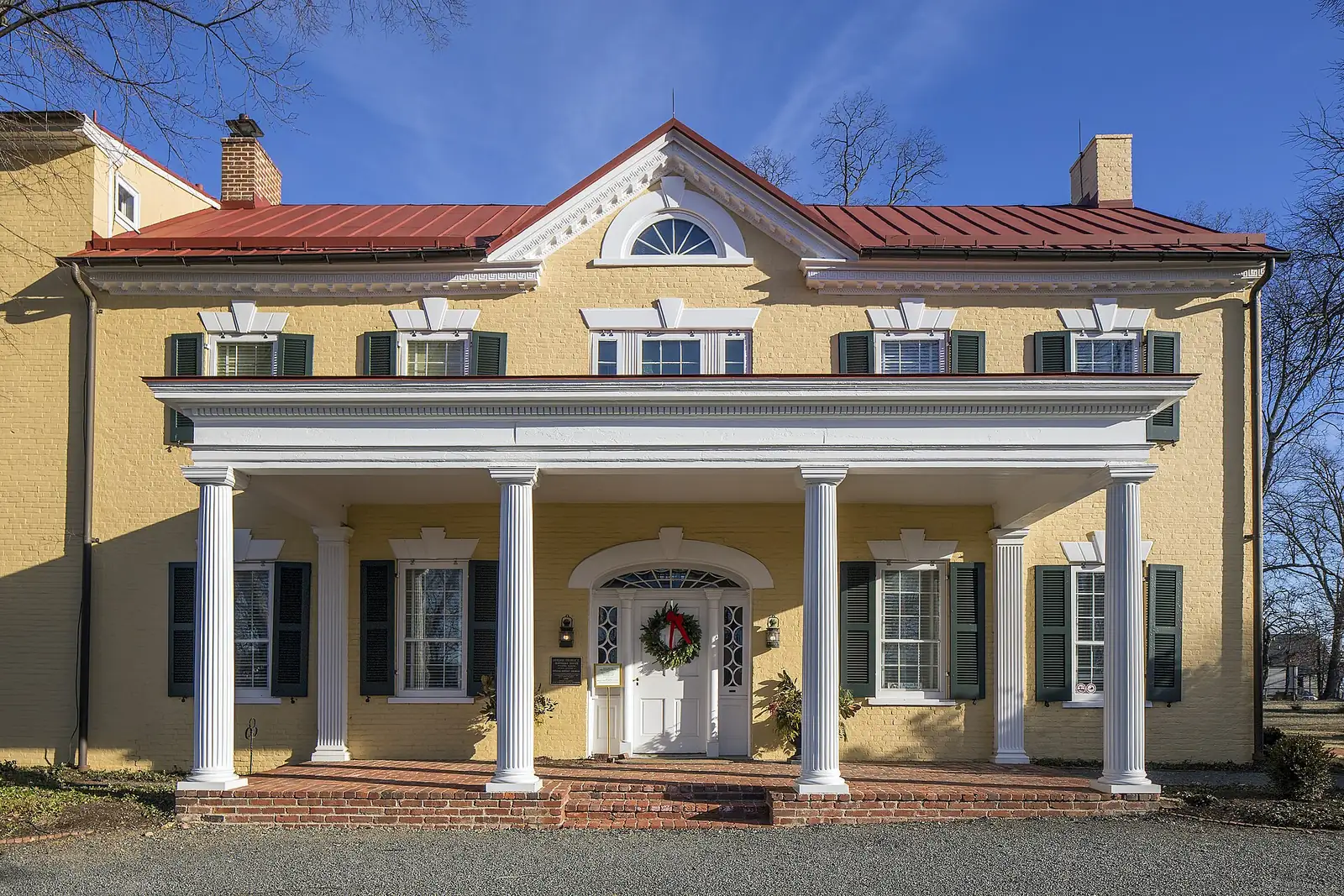
Leesburg was established by the Virginia Assembly in 1758 and incorporated Feb. 18, 1813. Here are its National Register sites, museums and battlefield.
Last checked Oct. 19, 2026. History comes from the Town of Leesburg’s Thomas Balch Library History of Leesburg; listings and dates from the National Park Service’s National Register of Historic Places data (May 22, 2026, file); visitor hours from each site’s own website.
Leesburg was established by an Act of the Virginia Assembly in September 1758 and incorporated on Feb. 18, 1813. It has been the seat of Loudoun County since the Assembly chose the settlement for the county courthouse in 1757. For local history questions, the town’s Thomas Balch Library, 208 W. Market St., answers at 703-737-7195.
Who to call
- Thomas Balch Library (local history, genealogy, research): 703-737-7195
- Loudoun Museum: 703-777-7427
- George C. Marshall International Center (Dodona Manor tours): 703-777-1301
- Morven Park: 703-777-2414
- Ball’s Bluff Battlefield Regional Park: 703-779-9372
How Leesburg began
The land that became Leesburg was part of 4,054 acres granted to Francis Awbrey in 1730 by Thomas, the 6th Lord Fairfax, the Balch Library history says. A settlement grew where the north-south Carolina Road, now U.S. 15, crossed the east-west Potomac Ridge Road, now Route 7.
Nicholas Minor owned 60 acres there and hired John Hough to survey them into 70 lots, a town he called George Town. In 1757 the Assembly picked the settlement for the Loudoun County courthouse. The September 1758 act officially established the town and renamed it Leesburg, for the Lee family. The first trustees were Minor, Philip Ludwell Lee and Francis Lightfoot Lee. Minor’s 1759 revised map, which survives, shows the 70 lots divided by three north-south and four east-west streets.
Key dates, from the same history:
- June 1774: Leesburg and Loudoun freeholders, meeting in Leesburg, passed the Loudoun County Resolves in response to British taxation.
- 1761: the first courthouse went up at Market and King streets. A second replaced it in 1811, and the third, which still stands, was built on the same corner in 1894.
- War of 1812: with the British advancing on Washington, the Declaration of Independence, the Constitution and other federal papers were hidden in a vacant Leesburg house.
- Feb. 18, 1813: the General Assembly signed the Act of Incorporation, giving the town elected officials to pass its own laws.
- 1820: the Leesburg Turnpike, today’s Route 7, opened, tying Valley farmers more closely to merchants in Alexandria and Georgetown.
- 1825: the Marquis de Lafayette was honored in Leesburg on his farewell tour of the United States.
- Oct. 21, 1861: the Battle of Ball’s Bluff was fought on a bluff overlooking the Potomac River, according to NOVA Parks.
The library’s history continues through the Civil War, Reconstruction and the postwar boom on its History of Leesburg pages.
The historic district
The Leesburg Historic District, the original town centered on the crossing of King Street (U.S. 15 Business) and Market Street, was listed on the National Register on Feb. 26, 1970, covering 365 acres. A boundary increase listed May 22, 2002, added 177.5 acres roughly bounded by North and Union streets, Morven Park Road and Harrison Street, according to the Park Service data.
National Register listings in the town
These nine listings sit inside the town, with the date each was listed, from the National Park Service file:
| Listing | Address | Listed |
|---|---|---|
| Leesburg Historic District | Original town around King and Market streets | Feb. 26, 1970 (expanded May 22, 2002) |
| Waverly | 212 S. King St. | Feb. 10, 1983 |
| Edward Nichols House | 330 W. Market St. | Dec. 4, 1987 |
| Old Stone Church Archeological Site | Address restricted by the Park Service | Sept. 7, 1989 |
| Douglass High School | 408 E. Market St. | Sept. 24, 1992 |
| Gen. George C. Marshall House (Dodona Manor) | 217 Edwards Ferry Road | June 19, 1996; National Historic Landmark the same day |
| Rock Spring Farm | 329 Loudoun St. SW | March 13, 2002 |
| Union Street School | 20 Union St. | Feb. 14, 2023 |
| Loudoun County Courthouse | 10 N. King St. | Dec. 13, 2024, as a National Historic Landmark |
The 1883 Union Street School is an intact African American schoolhouse from the Jim Crow era of segregation, also called the Leesburg Training School in the 1930s, according to the Virginia Department of Historic Resources’ nomination. Loudoun County is rehabilitating the Union Street School for public use.
Just outside the town limits, with Leesburg addresses: Morven Park (1975), Ball’s Bluff Battlefield Historic District and National Cemetery (1984, also a National Historic Landmark), Exeter (1973), Rockland (1987), Carlheim (1979), Rokeby (1976), Woodburn (1976), Murray Hill (2014), Oatlands (1969) and James Monroe’s Oak Hill (1966), about eight miles south on U.S. 15.
Museums and sites you can visit
- Loudoun Museum, 16 Loudoun St. SW, 703-777-7427. Open 10 a.m. to 4 p.m. Friday to Sunday, free admission; closed Thanksgiving, Christmas and Easter. The garage next door is free on weekends, the museum says.
- George C. Marshall House (Dodona Manor), 217 Edwards Ferry Road. Docent-led interior tours 11 a.m. to 2 p.m. Friday and Sunday and 10 a.m. to 3:30 p.m. Saturday; about 75 minutes. Free self-guided exterior tours. Tickets and schedule on the Marshall Center’s site; 703-777-1301.
- Morven Park, 17195 Southern Planter Lane, 703-777-2414. Guided Davis Mansion tours at 10 and 11 a.m. and 1, 2 and 3 p.m. Friday to Monday; arrive 10 minutes early, says Morven Park. The estate also holds the Winmill Carriage Museum and the Museum of Hounds and Hunting of North America.
- Ball’s Bluff Battlefield Regional Park and National Cemetery, Ball’s Bluff Road. Open dawn to dusk for walking and self-guided tours; guided tours at 11 a.m. and 1 p.m. Saturdays and Sundays, April to November, from the parking lot kiosk. The cemetery is the third smallest national cemetery in the country, NOVA Parks says.
- Thomas Balch Library, 208 W. Market St., 703-737-7195, the town’s history and genealogy library, with a free self-guided walking tour, “Explore 18th Century Leesburg!”, among its digital exhibits.
Related guides: parks and trails, things to do this month, population and growth and your town, county and neighbors.
Frequently asked questions
When was Leesburg, Virginia founded?
An Act of the Virginia Assembly in September 1758 officially established the town and named it Leesburg, for the Lee family, according to the town’s Thomas Balch Library.
When was Leesburg incorporated?
The General Assembly signed the Act of Incorporation of the Town of Leesburg on Feb. 18, 1813, giving the town elected officials who could pass its own laws.
What was Leesburg called before it was Leesburg?
Nicholas Minor, who owned the land and had it platted into 70 lots, called his town George Town, the Balch Library history says.
How many National Register sites are in Leesburg?
Nine National Park Service listings sit inside the town: the Leesburg Historic District and eight individual sites, including the Loudoun County Courthouse and the George C. Marshall House, both National Historic Landmarks.
Is the Loudoun Museum free?
Yes. The Loudoun Museum at 16 Loudoun St. SW is open 10 a.m. to 4 p.m. Friday to Sunday with free admission, according to the museum.
Have your say